
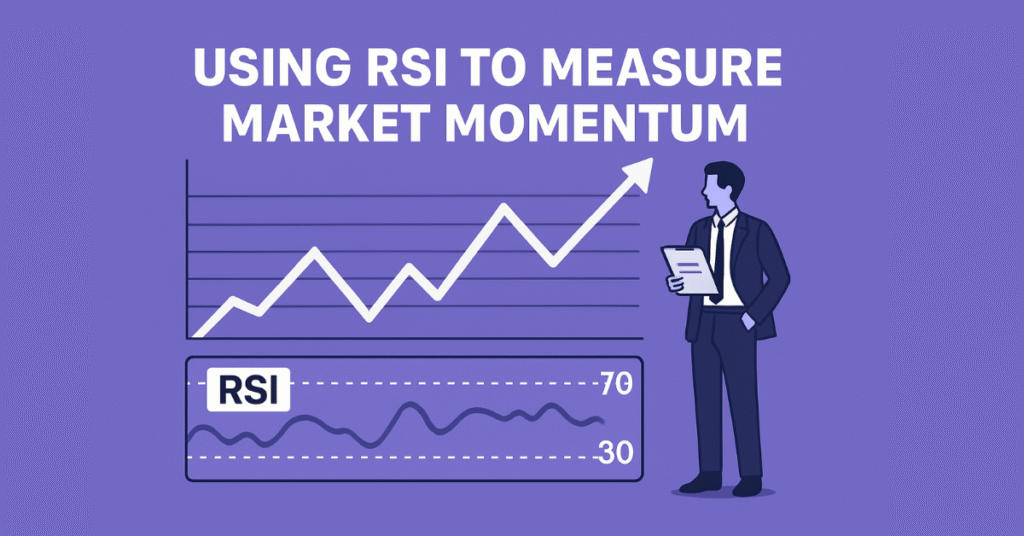
Understanding market momentum is vital for traders and analysts who want to assess the strength of a trend. The Relative Strength Index (RSI) is one of the most reliable indicators used to measure momentum in financial markets. It helps traders recognize when a market is gaining or losing strength, identify overbought and oversold signals, and build an effective RSI trading strategy for better timing of entries and exits.
This article explains how RSI works, how it measures market momentum, and how professionals use it to make informed trading decisions.
What Is the Relative Strength Index (RSI)?
The Relative Strength Index (RSI) is a momentum oscillator that measures the speed and magnitude of price changes. Created by J. Welles Wilder Jr. in 1978, RSI has become a key technical tool across forex, stock, and commodity markets, alongside other forex indicators that provide insights into market momentum and trend strength. It moves between values of 0 and 100, showing whether an asset is potentially overbought or oversold.
RSI Formula
The formula for RSI is:
RSI = 100 – (100 / (1 + RS))
Where RS (Relative Strength) equals the average gain divided by the average loss over a selected period, usually 14 periods.
For example, if a currency pair increases on nine days and decreases on five days during a 14-day period:
- Average gain = 0.6%
- Average loss = 0.4%
Then RS = 0.6 ÷ 0.4 = 1.5
RSI = 100 – [100 / (1 + 1.5)] = 60
An RSI value of 60 indicates moderate bullish momentum, suggesting that buying pressure is currently stronger than selling pressure.
How RSI Measures Market Momentum
RSI tracks the relationship between recent gains and losses to evaluate whether price momentum is strengthening or weakening. When momentum increases, the RSI line rises, one of the best forex indicators that helps traders monitor shifts in price momentum efficiently. When momentum slows, the RSI line falls.
Key RSI Levels
- RSI above 70 signals potential overbought conditions.
- RSI below 30 signals potential oversold conditions.
- RSI near 50 indicates balance between buyers and sellers.
For example, if the EUR/USD pair’s RSI rises from 45 to 70 within a week, it shows that bullish momentum is accelerating. If RSI then falls back toward 50 while the price continues rising slightly, it can suggest that buying pressure is fading—a potential sign of reversal.
Understanding Overbought and Oversold Signals
The most common use of RSI is identifying overbought and oversold signals.
Overbought Conditions (RSI Above 70)
- The market may have moved up too quickly.
- A pullback or correction may be near.
- Traders often prepare to take profits or open short positions.
Oversold Conditions (RSI Below 30)
- The market may have declined too rapidly.
- A rebound or upward correction could follow.
- Traders may look for long entry opportunities.
For example, if the GBP/USD pair’s RSI reaches 78, traders interpret this as overbought. A move back below 70 could suggest a potential selling opportunity. On the other hand, if RSI drops to 25 after a prolonged decline, it may indicate that sellers are exhausted, prompting buyers to re-enter.
The RSI Trading Strategy Explained
A simple RSI trading strategy uses overbought and oversold zones to find trades with better probability. There are several ways strategists apply it effectively.
1. Overbought and Oversold Reversal Strategy
This basic strategy works best in range-bound markets: Leveraging trading tools like RSI provides traders with more reliable entry and exit points.
- Buy when RSI crosses above 30 after being oversold.
- Sell when RSI crosses below 70 after being overbought.
Example: In a sideways EUR/JPY market, if RSI dips to 28 and then rises above 30, traders may open a long position expecting a short-term rebound.
2. RSI Divergence Strategy
Divergence happens when RSI and price move in opposite directions. It often signals a possible trend reversal.
- Bullish Divergence: Price makes a lower low, but RSI makes a higher low.
- Bearish Divergence: Price makes a higher high, but RSI makes a lower high.
Example: If gold prices reach new highs while RSI fails to make a new high, momentum is weakening, and a downward reversal could follow.
3. RSI Trend Confirmation Strategy
Rather than only relying on overbought and oversold zones, traders also use RSI to confirm trend direction.
- During an uptrend, RSI tends to stay above 40–50.
- During a downtrend, RSI tends to stay below 50–60.
Example: In a strong USD/CAD uptrend, RSI repeatedly rebounds from 45 to 70 without falling below 40. This consistent pattern shows that buying momentum remains solid.
Adjusting RSI Settings for Different Trading Styles
The default RSI period is 14, but traders can adjust it depending on their time horizon.
| Trading Style | RSI Period | Description |
| Day Trading | 7 or 9 | Faster reaction to short-term price swings |
| Swing Trading | 14 | Balanced signal commonly used |
| Position Trading | 21 or more | Smoother readings, less noise |
A shorter period provides more frequent signals but increases false alerts. Longer periods offer smoother signals, reducing noise but delaying reaction times.
Combining RSI with Other Indicators
RSI works best when combined with other technical tools to confirm signals and improve accuracy. For example, risk calculators can help traders measure exposure before executing RSI-based trades.
Moving Averages
Using RSI with a 50-day or 200-day moving average helps determine whether the trend aligns with RSI readings.
- RSI rising above 50 while price trades above the 200-day average suggests strong bullish conditions.
- RSI falling below 50 while price remains under the average signals continued bearish strength.
Support and Resistance Levels
- RSI near overbought levels at resistance strengthens a potential reversal case.
- RSI near oversold levels at support suggests the market could bounce upward.
Volume Indicators
If an RSI signal occurs alongside rising volume, it becomes more reliable. Increased volume confirms that momentum shifts are supported by real market participation.
Combining RSI with these tools allows traders to validate signals and avoid premature entries.
How Market Strategists Use RSI
For a Market Strategist, RSI provides valuable insight into market behavior beyond single-trade opportunities. It helps assess broader momentum trends across multiple instruments and timeframes.
RSI for Cross-Market Comparison
By comparing RSI readings across several assets, strategists can identify where momentum is building or fading, which is a key use of forex indicators in broader market analysis.For instance, if the RSI for USD/JPY is climbing while the RSI for EUR/USD is falling, it signals relative strength in the U.S. dollar.
RSI for Timing Market Entries
Strategists often use RSI divergence on higher timeframes to fine-tune their entry or exit points. A weekly RSI moving down while the daily RSI moves up can indicate short-term recovery inside a longer-term decline.
RSI in Automated Systems
Many trading companies integrate RSI into their algorithmic models. Automated systems can:
- Trigger alerts when RSI reaches key levels.
- Combine RSI signals with moving averages or volatility filters.
- Execute trades based on predefined RSI thresholds.
This allows consistent execution without emotional bias and supports data-driven decision-making.
Limitations of RSI
RSI is a powerful momentum indicator, but it has its limitations.
- False Signals: In strong trending markets, RSI can remain overbought or oversold for extended periods, which highlights the importance of using it alongside other best forex indicators to avoid false signals.
- Lagging Indicator: Because RSI relies on historical data, it reacts after price moves have started.
- Best for Range Markets: RSI gives clearer signals when prices fluctuate within boundaries rather than during one-directional trends.
How to Reduce False Signals
- Combine RSI with trend-following indicators such as moving averages or MACD.
- Wait for confirmation candles before executing trades.
- Test alternative RSI thresholds like 80/20 instead of 70/30 for volatile markets.
Real-World Example: RSI on the EUR/USD Daily Chart
Consider an example using the EUR/USD pair. Over two weeks, prices steadily rise while RSI climbs to 76. This indicates overbought conditions. A few days later, RSI starts to fall back to 65 while price remains flat. The weakening RSI shows that bullish momentum is losing strength. A strategist might interpret this as an early signal to tighten stop-loss levels or take partial profits before a potential pullback.
Benefits of Using RSI in Market Analysis
The Relative Strength Index remains one of the simplest and most effective tools for analyzing market momentum. It converts price data into a single line that reflects strength, weakness, and potential turning points.
Main Benefits
- Identifies Momentum Shifts: Helps traders detect whether price momentum is increasing or slowing down.
- Clarifies Entry and Exit Zones: Provides visual signals for potential buy or sell opportunities.
- Simplifies Market Analysis: Transforms complex data into clear, readable information.
- Useful Across Timeframes: Suitable for intraday, daily, and weekly charts.
- Applicable Across Markets: Works in forex, stocks, commodities, and indices.
By interpreting RSI correctly, traders gain a clearer view of market behavior and make more disciplined decisions.
Tips for Using RSI Effectively
To make the most of RSI as a momentum indicator, traders should:
- Avoid using RSI alone; confirm with trend direction.
- Adjust RSI periods to match their trading style.
- Observe RSI behavior at key support and resistance zones.
- Look for divergence before trend reversals.
- Manage risk even when signals appear strong.
These practices help maintain consistency and prevent over-reliance on a single indicator.
Conclusion
The Relative Strength Index (RSI) remains one of the most practical tools for measuring market momentum. It allows traders to evaluate trend strength, identify overbought and oversold signals, and refine their RSI trading strategy with data-based confidence.
For market strategists and trading firms, RSI provides valuable information about momentum behavior across assets and timeframes. When combined with trend filters and confirmation indicators, it supports structured, objective analysis and helps reduce uncertainty in trading decisions.
By understanding how RSI operates and applying it consistently, traders can improve market timing, manage risk more effectively, and gain deeper insight into how momentum drives price movement.