
Introduction
In forex trading, moving averages are one of the most reliable and widely used technical indicators. They simplify price data, help identify trends, and guide traders in managing risk. Whether you are analyzing long-term currency pairs or short-term trades, understanding how moving averages in forex work is essential.
This article explains the mechanics of simple moving averages (SMA) and exponential moving averages (EMA), how they signal trends, and how they support effective risk control.
What Is a Moving Average in Forex?
A moving average is a technical indicator that smooths out price data by creating a constantly updated average price. Instead of focusing on individual price movements, it provides a clearer picture of the overall market trend.
In forex, moving averages are used to identify trend direction, detect potential reversals, and generate buy or sell signals. These are just a few examples of how forex indicators can help you make informed trading decisions.
Why Moving Averages Matter in Forex Analysis
Forex markets are known for their volatility. Prices can rise and fall within seconds due to global news or economic data. By using moving averages, traders can filter short-term fluctuations and focus on the broader market behavior.
Key Benefits
Moving averages simplify price data and help traders manage risk. They’re considered among the best forex indicators for trend analysis and risk control, making them a must-have tool for any forex trader.
- Clarity: Moving averages simplify price data, making it easier to read trends.
- Trend Confirmation: They confirm whether the price is trending or consolidating.
- Entry and Exit Guidance: They generate signals when the market crosses certain price levels.
- Risk Control: They help define stop-loss and take-profit levels based on market direction.
Types of Moving Averages in Forex
There are many types of moving averages, but two are most common in forex trading.
1. Simple Moving Average (SMA)
The simple moving average calculates the average price of a currency pair over a specific number of periods. It gives equal weight to all data points in that time frame.
Formula:
SMA = (P₁ + P₂ + … + Pₙ) / n
Where:
- P = closing price for each period
- n = number of periods used
Example:
A 20-day SMA adds the closing prices of the last 20 days and divides by 20. This line updates daily, showing the average price over the last 20 days.
Key Features:
- Easy to calculate and interpret
- Works well for identifying long-term trends
- Responds slowly to price changes
2. Exponential Moving Average (EMA)
The exponential moving average gives more weight to recent prices. It reacts faster to new market data compared to the SMA.
Formula (simplified):
EMA = (Price today × Multiplier) + (EMA yesterday × (1 – Multiplier))
Multiplier = 2 / (n + 1)
Example:
If you use a 10-day EMA, the latest prices have a greater effect on the moving average than older data.
Key Features:
- Responds quickly to price movements
- Useful for short-term trading strategies
- Helps detect early trend reversals
SMA vs EMA: Which Is Better for Forex Trading?
Both SMA and EMA are effective, but their use depends on your trading style.
| Feature | Simple Moving Average (SMA) | Exponential Moving Average (EMA) |
| Calculation | Equal weight to all prices | More weight to recent prices |
| Reaction Speed | Slower | Faster |
| Best For | Long-term trends | Short-term trades |
| Noise Sensitivity | Less sensitive | More sensitive |
Both SMA and EMA are powerful trading tools that help traders navigate through different market conditions, with their specific strengths suited for varying timeframes and strategies.
Practical Use
- SMA helps identify stable, long-term market directions.
- EMA works better in volatile markets where quick responses are needed.
For example, a 50-day SMA can help confirm the overall market trend, while a 10-day EMA can signal short-term opportunities.
How Moving Averages Signal Trends
1. Trend Identification
Moving averages help traders quickly determine if the market is trending upward or downward.
- Uptrend: Price stays above the moving average.
- Downtrend: Price remains below the moving average.
- Sideways: Price crosses the moving average frequently.
2. Crossovers
Crossovers are one of the most popular trading signals generated by moving averages.
- Golden Cross: When a short-term moving average (e.g., 50-day) crosses above a long-term moving average (e.g., 200-day). It suggests a bullish trend.
- Death Cross: When a short-term moving average crosses below a long-term moving average. It signals a bearish trend.
Crossovers are some of the most popular forex indicators used to signal momentum shifts in the market, such as the Golden Cross or Death Cross, which help traders identify the best times to enter or exit positions.
These crossover signals are widely used in forex for identifying momentum shifts.
3. Dynamic Support and Resistance
Moving averages often act as support or resistance levels. When prices pull back to the moving average and then rebound, it confirms the trend direction.
For example:
- In an uptrend, the moving average acts as support.
- In a downtrend, it acts as resistance.
Using Moving Averages for Risk Control
Beyond identifying trends, moving averages are valuable tools for managing trading risk.
1. Setting Stop-Loss Levels
Traders often set stop-loss orders just below a moving average in an uptrend or above it in a downtrend. This helps protect against unexpected reversals.
2. Defining Position Size
If the market moves close to a moving average, traders can reduce position size to minimize exposure until a clear signal appears.
3. Avoiding False Signals
Using multiple moving averages helps confirm real trends and avoid false entries. For example, waiting for both 10-day and 50-day EMAs to align in the same direction before opening a position increases accuracy.
Common Moving Average Strategies in Forex
1. Single Moving Average Strategy
A simple strategy using one moving average line. When the price crosses above the moving average, traders may consider buying. When it crosses below, they may consider selling.
Ideal for: Beginners or traders focusing on trend direction rather than short-term fluctuations.
2. Dual Moving Average Crossover Strategy
This method uses two moving averages — one short-term and one long-term.
- Buy Signal: Short-term MA crosses above long-term MA
- Sell Signal: Short-term MA crosses below long-term MA
Example: Use a 10-day EMA and a 50-day EMA to identify entry and exit points.
3. Triple Moving Average Strategy
Involves three different moving averages — short, medium, and long term.
Example Setup:
- 10-day EMA
- 50-day EMA
- 200-day SMA
When all three align in one direction, it signals a strong trend confirmation.
4. Moving Average Channel
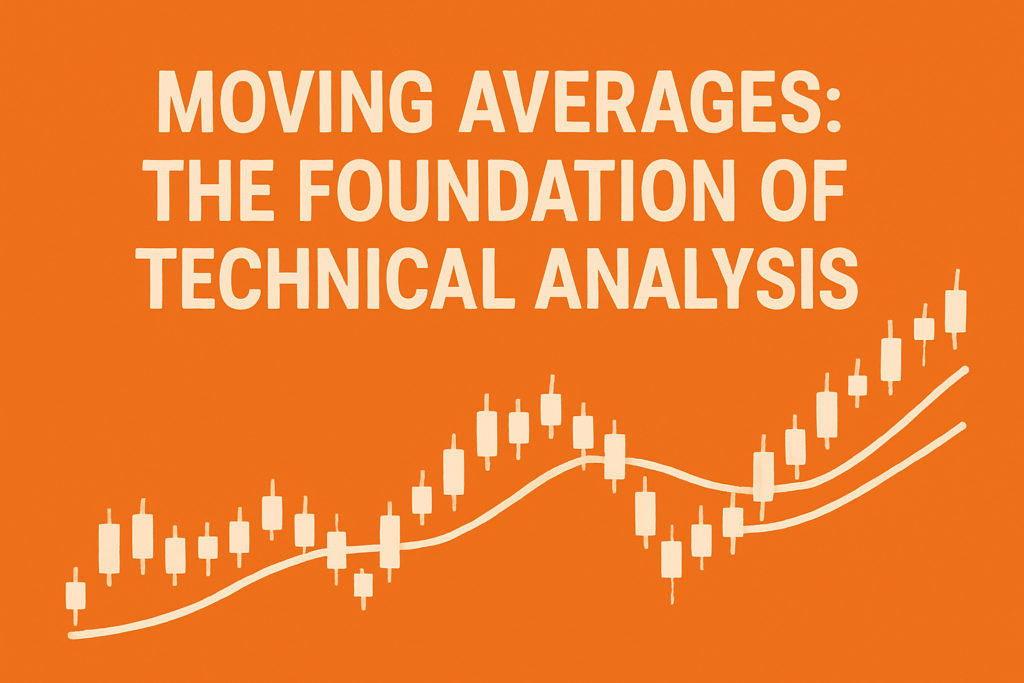
Traders can also create a channel by plotting two moving averages above and below the main trend line. This helps visualize potential price zones and volatility.
In addition to moving averages, traders often rely on risk calculators to fine-tune their position sizes, ensuring that they can enter trades safely while managing potential exposure to market volatility.
Best Settings for Moving Averages in Forex
There’s no single best setting for all traders. Settings vary based on trading style, timeframe, and currency pair volatility.
| Trading Style | Common Periods | Recommended Type |
| Scalping | 5, 10, 20 | EMA |
| Swing Trading | 20, 50, 100 | SMA or EMA |
| Position Trading | 100, 200 | SMA |
Tip: Test different settings on demo accounts before applying them to live trades.
Common Mistakes to Avoid When Using Moving Averages
- Relying on one indicator: Moving averages should confirm other signals, not act alone.
- Ignoring market conditions: In ranging markets, moving averages can produce false signals.
- Using too many averages: Multiple lines can confuse rather than clarify.
- Failing to adjust settings: Different timeframes require different period lengths.
- Late reactions: Moving averages are lagging indicators; they follow price action, not lead it.
Combining Moving Averages with Other Indicators
Moving averages become more effective when combined with other tools.
- Relative Strength Index (RSI): Confirms overbought or oversold conditions.
- MACD (Moving Average Convergence Divergence): Measures momentum using moving averages.
- Bollinger Bands: Uses moving averages to track volatility and price range.
To further improve accuracy, combining moving averages with other best forex indicators like RSI, MACD, or Bollinger Bands can provide more reliable trading signals and confirm market trends.
Example: Using EMA for Short-Term Forex Trades
Let’s consider the EUR/USD pair using a 10-day EMA and a 50-day EMA.
- Step 1: Apply both EMAs to the chart.
- Step 2: Wait for the 10-day EMA to cross above the 50-day EMA. This signals a possible upward trend.
- Step 3: Confirm with volume or RSI before entering the trade.
- Step 4: Set a stop-loss just below the 50-day EMA.
- Step 5: Exit when the 10-day EMA crosses below again.
This method reduces risk while allowing traders to follow the trend efficiently.
The Role of Moving Averages in Automated Trading Systems
Many trading bots and algorithmic systems use moving averages as part of their decision rules. They provide a consistent, data-driven method to define entry and exit points.
Advantages in automation:
- Removes emotional bias
- Ensures consistent decision-making
- Works across multiple timeframes and instruments
By integrating SMA and EMA logic, developers can build automated forex strategies that adapt to market behavior with minimal manual intervention.
Conclusion
Moving averages remain one of the most practical and essential tools in forex technical analysis. They simplify price action, help identify trends, and provide structure for risk control.
For technical analysts, understanding how to use simple moving averages and exponential moving averages effectively can greatly improve trading accuracy and confidence.
Whether used manually or within automated systems, moving averages in forex form the backbone of data-driven trading, allowing traders to make clear, consistent, and informed decisions in every market condition.