
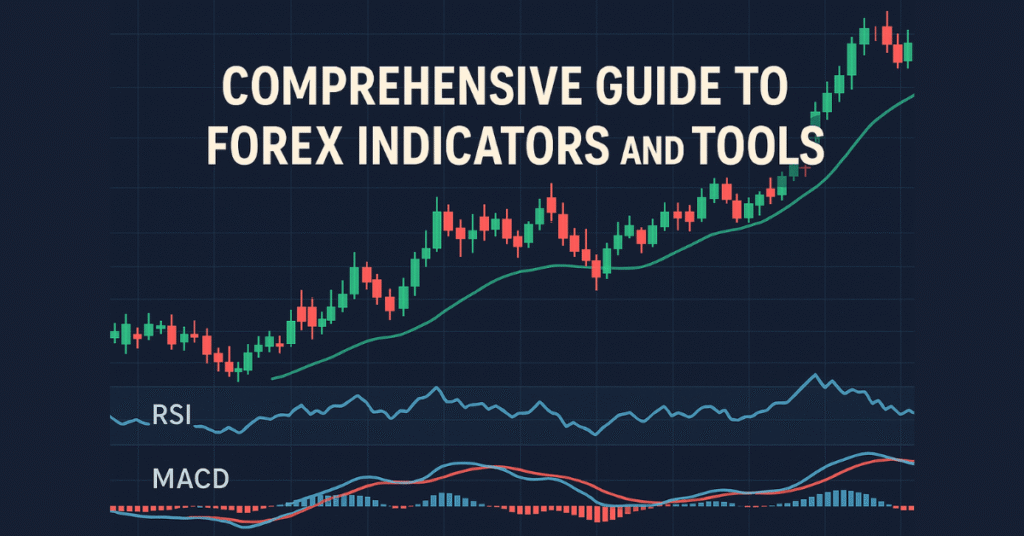
Forex trading is a dynamic, fast-paced market that demands precise decision-making. Traders use various tools and indicators to analyze currency price movements and predict future trends. This guide covers essential Forex indicators and tools every trader should know to navigate the Forex market efficiently.
What Are Forex Indicators?
Forex indicators are mathematical calculations based on historical price, volume, and open interest data. These indicators help traders analyze the current market trends and predict future movements. They are key to making informed trading decisions and managing risks.
Types of Forex Indicators
Forex indicators can be categorized into several types based on their functionality and the kind of data they analyze. These include trend indicators, momentum indicators, volatility indicators, and volume indicators.
Trend Indicators: Understanding Market Direction
Trend indicators help traders identify the overall direction of a market, whether it’s an uptrend, downtrend, or sideways movement.
Moving Averages (MA)
- Simple Moving Average (SMA): This is one of the most commonly used trend indicators. It calculates the average price over a specific period, smoothing out price fluctuations.
- Exponential Moving Average (EMA): Unlike the SMA, the EMA gives more weight to recent prices, making it more sensitive to price changes.
Average Directional Index (ADX)
- ADX is used to determine the strength of a trend. The value of ADX ranges from 0 to 100, where values above 25 indicate a strong trend, and values below 20 suggest weak or no trend.
Parabolic SAR (Stop and Reverse)
- The Parabolic SAR is used to identify potential trend reversals. It appears as dots above or below the price chart, signaling when a trend might be about to change direction.
Momentum Indicators: Measuring Speed of Market Moves
Momentum indicators measure the strength or speed of price movement. These indicators help traders assess whether a trend is gaining or losing strength.
Relative Strength Index (RSI)
- RSI is one of the most popular momentum indicators. It measures the speed and change of price movements, helping traders identify overbought or oversold conditions. The RSI ranges from 0 to 100, with values above 70 indicating an overbought condition and values below 30 indicating an oversold condition.
Stochastic Oscillator
- The Stochastic Oscillator compares a closing price to its price range over a specific period. It generates values between 0 and 100, helping traders identify potential reversal points.
Volatility Indicators: Analyzing Price Fluctuations
Volatility indicators provide insights into the degree of price movement over a given time. These indicators help traders assess the potential risk and reward of a trade.
Bollinger Bands
- Bollinger Bands consist of a simple moving average and two standard deviations. The bands expand and contract based on market volatility, helping traders identify overbought and oversold conditions.
Average True Range (ATR)
- ATR measures market volatility by calculating the average range between high and low prices over a given period. A higher ATR suggests increased volatility, while a lower ATR indicates a calm market.
Volume Indicators: Understanding Market Activity
Volume indicators analyze the number of shares or contracts traded over a specific period. They help traders assess the strength of a price movement and whether it is supported by adequate market participation.
On-Balance Volume (OBV)
- OBV is a cumulative volume indicator that adds volume on up days and subtracts volume on down days. It helps identify whether price movements are supported by high or low trading volumes.
Volume Moving Average
- This indicator averages the volume over a specific period and can be used in conjunction with price action to identify potential trend reversals.
Risk Calculators: Managing Risk in Forex Trading
Risk management is crucial to successful Forex trading. Risk calculators are tools that help traders manage and assess the risk involved in a trade.
Position Size Calculator
- A Position Size Calculator helps determine the correct position size based on account balance, stop loss, and risk tolerance. It ensures that traders don’t risk more than they can afford to lose.
Risk-to-Reward Ratio Calculator
- A Risk-to-Reward Ratio Calculator helps traders assess whether a trade is worth the risk. It compares the potential profit with the potential loss to determine whether the trade is favorable.
The Best Forex Tools for Traders
In addition to indicators, traders use various tools to enhance their trading strategies and increase efficiency. These tools can help with technical analysis, strategy automation, and risk management.
Trading Platforms
- MetaTrader 4 (MT4) and MetaTrader 5 (MT5) are two of the most widely used platforms in Forex trading. These platforms allow traders to implement automated trading strategies, backtest their methods, and execute trades with ease.
Economic Calendars
- Economic calendars provide a schedule of important economic events and data releases, such as central bank announcements and economic indicators. Traders use these calendars to anticipate market-moving events.
Trading Bots and Algorithms
- Trading bots and algorithms can automate trading strategies, allowing traders to execute trades 24/7 without emotional bias. These tools can be used to implement risk management strategies and backtest trading ideas.
How to Choose the Right Forex Indicator and Tool
Choosing the right Forex indicator and tool depends on your trading style, goals, and the market conditions. Here are some tips for selecting the right tools:
- Understand Your Trading Style: Trend-following traders may prefer indicators like moving averages, while momentum traders might rely on RSI or Stochastic Oscillator.
- Use Multiple Indicators: Combining different types of indicators can help confirm signals and improve the accuracy of your trades.
- Start with Simplicity: Avoid overwhelming yourself with too many tools. Focus on a few reliable indicators that work well with your strategy.
- Test and Optimize: Backtest your indicators and tools on historical data before using them in live trading. This will help you understand their effectiveness and adjust them as needed.
The Psychological Aspect of Using Forex Indicators
Trading psychology plays a significant role in how indicators are used. Indicators provide valuable data, but without emotional control, traders might misinterpret signals or make impulsive decisions. The following points are important to understand when using indicators:
- Avoid Overtrading: Trading with indicators can sometimes tempt traders to act too quickly. Overtrading, driven by impatience or overconfidence, can lead to poor decision-making.
- Managing Emotional Responses: Indicators are designed to provide objective data. However, traders may sometimes let their emotions (e.g., fear or greed) influence their actions. It’s essential to rely on indicators as part of a disciplined strategy.
- Building Confidence: Successful traders use indicators to build confidence in their decisions, knowing that their strategies are backed by data rather than emotions.
By understanding the psychological aspect of trading, traders can avoid pitfalls that arise from impulsive or emotional actions and use indicators to make clear-headed, well-informed decisions.
Indicators vs. Price Action: Which One to Choose?
One of the fundamental debates in Forex trading is whether to rely on indicators or price action. Here’s how they compare:
- Indicators: These provide quantitative data based on past price movements, helping traders make decisions by analyzing trends, momentum, and volatility.
- Price Action: Price action trading focuses on the raw price movements themselves, without relying on external tools. Traders observe patterns and chart formations to determine the market’s behavior.
Both approaches have their advantages. Indicators can provide extra confirmation of price movements, while price action focuses on the core market data. The key is to understand when and how to use each one. Many successful traders combine both methods to refine their strategies.
How to Customize Forex Indicators for Your Trading Style
One of the advantages of using Forex indicators is the ability to customize them to suit your trading style. Customizing indicators can improve the accuracy and efficiency of your trading strategy. Here’s how:
- Adjusting Time Frames: Depending on whether you’re trading on a 5-minute chart or a daily chart, you can adjust indicators like the moving average (MA) or RSI to reflect the appropriate time frames for your trades.
- Optimizing for Volatility: For more volatile market conditions, you can tweak volatility indicators like the Average True Range (ATR) to respond faster to price movements.
- Combining Indicators: Rather than relying on one indicator, many traders combine different tools (e.g., MACD and RSI) to get a more well-rounded view of market conditions.
By customizing your indicators to match your trading style and the current market conditions, you can create a strategy that suits your risk tolerance and trading goals.
The Impact of Global Economic Events on Forex Indicators
Global events such as central bank decisions, geopolitical instability, and economic reports can significantly affect currency prices. These events often cause market volatility, which can influence the effectiveness of certain indicators. Here’s how:
- Interest Rate Changes: Central banks like the Federal Reserve or European Central Bank frequently announce interest rate decisions that influence currency values. Indicators like the ADX (Average Directional Index) and moving averages often become more volatile following such events.
- Geopolitical Tensions: Events like elections, conflicts, or trade tensions can lead to currency fluctuations, making it essential to adjust indicators that rely on historical data (like moving averages) to adapt to sudden changes.
- Economic Reports: Economic reports such as GDP data, inflation, and employment statistics can influence price movements. Economic calendars and real-time indicators can help traders anticipate and react to such events.
Traders need to be mindful of upcoming economic events and adjust their indicator settings or trading strategy accordingly to navigate market shifts.
Indicators for Scalping Strategies
Scalping involves making quick trades over short time frames to capture small price movements. Certain indicators are ideal for scalping because they can help identify trends and reversals quickly.
- Moving Averages: Short-term moving averages (e.g., 5-period or 10-period MA) are useful for identifying short-term trends in scalping strategies.
- RSI: The Relative Strength Index (RSI) can help scalpers identify overbought or oversold conditions, indicating potential reversal points.
- Stochastic Oscillator: This momentum indicator helps scalpers pinpoint short-term price movements that may be ripe for a quick trade.
By using these indicators, scalpers can take advantage of small price fluctuations while keeping their trades quick and efficient.
The Role of Forex Indicators in Algorithmic Trading
Algorithmic trading, or “algo trading,” relies heavily on indicators and automated strategies. By using algorithms, traders can set parameters for executing trades based on specific indicator signals, such as when a moving average crosses or when RSI indicates overbought conditions.
- Backtesting with Indicators: Before using an algorithmic strategy in live markets, traders can backtest it using historical data to assess the performance of different indicators.
- Execution Speed: Algorithms can execute trades faster than manual traders, which is particularly useful when using indicators for high-frequency trading strategies.
By integrating indicators with algorithmic trading platforms, traders can automate their strategies, reduce emotional trading, and execute orders with precision.
Forex Indicators for Hedging and Risk Diversification
Hedging is a strategy that traders use to protect their positions from unfavorable market movements. By using indicators to spot potential risks, traders can hedge their positions more effectively.
- Correlation Indicators: Correlation indicators can help identify currency pairs that move in opposite directions. Traders can use this information to hedge against potential losses in one position by taking the opposite position in another correlated pair.
- ATR and Stop-Loss Placement: The Average True Range (ATR) can help traders determine appropriate stop-loss levels based on the current market volatility.
Effective use of risk management tools and indicators can help traders hedge their positions and minimize potential losses.
How to Use Forex Indicators for Long-Term Position Trading
Position traders hold their trades for longer periods, ranging from weeks to months, making long-term indicators essential. These indicators focus on identifying major trends rather than short-term price fluctuations.
- 200-Day Moving Average: The 200-day MA is commonly used by position traders to identify the overall trend direction. When the price is above the 200-day MA, it indicates an uptrend; below it signals a downtrend.
- Fibonacci Retracement Levels: Position traders use Fibonacci retracement levels to identify potential support and resistance levels for longer-term trades.
By combining these indicators, position traders can gain a clearer picture of long-term market trends and make more informed decisions.
Backtesting and Forward Testing with Forex Indicators
Testing the effectiveness of Forex indicators is crucial to ensure that your strategy works in live market conditions. Backtesting involves running a strategy on historical data, while forward testing is done with live market data but with a demo account.
- Backtesting: Traders can use platforms like MetaTrader or TradingView to test their strategies over historical data, allowing them to assess the potential profitability of indicators.
- Forward Testing: Once backtesting results are satisfactory, traders can forward test their strategy using a demo account to simulate real-time conditions without risking actual capital.
Both backtesting and forward testing provide valuable insights into the performance of your strategy, helping to refine your approach before executing trades in a live market.
How to Combine Forex Indicators with Other Technical Analysis Tools
While indicators are powerful tools, combining them with other technical analysis methods can enhance their effectiveness.
- Candlestick Patterns: Traders can combine indicators like RSI or MACD with candlestick patterns to confirm signals and identify potential trend reversals.
- Support and Resistance Levels: By combining indicators with key support and resistance levels, traders can identify high-probability trade setups.
Using multiple tools in conjunction allows traders to refine their strategies and increase the probability of successful trades.
Conclusion
Forex trading is a skill that requires the use of various tools and indicators to gain insights into the market. By understanding the different types of Forex indicators—trend indicators, momentum indicators, volatility indicators, and volume indicators—traders can make more informed decisions. Additionally, utilizing risk calculators, backtesting, and algorithmic trading can enhance trading strategies, ensuring consistency and success in the long term.
By combining indicators with sound trading psychology and risk management, traders can improve their chances of success in the dynamic world of Forex trading.